
Responsible Gambling
Gambling is a form of entertainment that carries real financial and psychological risk. If it stops being fun, or if someone close to you is struggling, help is free and confidential. This page lists the crisis helplines first, then walks through every tool a licensed Australian operator must offer — including step-by-step instructions for BetStop, deposit limits and self-exclusion on Roo Casino.
🆘 Talk to someone now
Gambling Help Online — 1800 858 858 · 24/7, free, confidential counselling for Australians.
Lifeline Australia — 13 11 14 · 24/7 crisis support.
Gamblers Anonymous Australia · peer-support meetings nationwide.
BetStop — the National Self-Exclusion Register · free, government-run, excludes you from all licensed Australian online gambling providers for 3 months to lifetime.
Warning signs
The Productivity Commission's 2010 gambling inquiry and subsequent Australian Gambling Research Centre work identify a consistent cluster of behaviours that predate financial harm by weeks or months. If more than one of these applies to you or someone close to you, it is worth a confidential call to Gambling Help Online before the behaviour compounds.
- Chasing losses — depositing again to "win it back" in the same session.
- Scope creep in bankroll — gambling more than planned, or with money meant for rent, food or bills.
- Hiding deposits from family members, or clearing the browser history after playing.
- Mood coupling — feeling anxious, irritable or depressed when not gambling.
- Functional impact — missing work, sleep or social events because of gambling.
- Tolerance — needing larger deposits or stakes to feel the same excitement.
- Failed attempts to stop — setting self-limits and breaking them more than once.
Tools every licensed Australian operator must offer
Under ACMA's National Consumer Protection Framework for Online Wagering, every licensed Australian-facing operator is required to provide a specific list of responsible-gambling tools. These are not optional features — they are licence conditions.
- Deposit limits — daily, weekly or monthly caps set in account settings. Decreases apply instantly. Increases have a mandatory 7-day cooling-off period.
- Activity statements — a 12-month deposit/withdrawal summary available on request within 7 days.
- Reality checks — pop-ups after a set session length (default 60 minutes, configurable from 15 minutes up).
- Self-exclusion — 6 months to permanent, processed within 24 hours and non-reversible for the chosen term.
- Opt-out of direct marketing — must be honoured within 2 business days and sticky to the account thereafter.
- Pre-commitment messaging — visible indicators of session time, net position and deposit cumulatives.
- BetStop integration — one federal register, blocks every licensed operator at once.
How to set a deposit limit on Roo Casino
- Log in and open Account → Responsible Gambling.
- Choose Daily, Weekly or Monthly limit.
- Enter the amount in AUD and save. Decreases apply immediately; increases take 7 days.
- The screen confirms the new limit with an on-screen timestamp — screenshot it for your records.
- You can stack limits: e.g. AUD 200 daily and AUD 1,000 monthly. The stricter limit wins.
Deposit-limit maths — picking a realistic number
"What should I set?" is the most common question we see. A defensible starting point from Australian Gambling Research Centre guidance: no more than 1 % of monthly disposable income per month, and never money that overlaps with fixed obligations.
Worked example. Take-home pay AUD 5,500 / month. Fixed costs (rent, bills, food, transport): AUD 3,500. Savings: AUD 1,500. Disposable: AUD 500. A 1 % cap would be AUD 5 / month — which is not a useful limit. A more workable "entertainment" figure is 5–10 % of disposable (AUD 25–50 / month). Treat it as money spent on a movie ticket, not an investment.
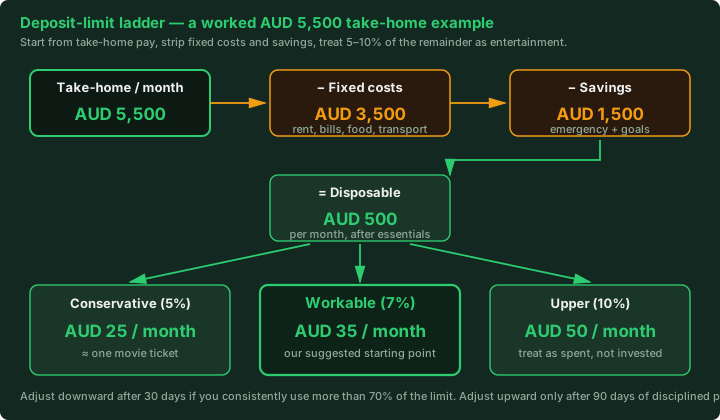
Figure 1 · Deriving a realistic monthly deposit limit from take-home pay. The AUD 35 figure is our suggested starting point for a median Australian take-home.
Adjust downward after 30 days if you consistently use more than 70 % of the limit. Adjust upward only after 90 days of disciplined play — and remember the 7-day cooling-off period is a feature, not an obstacle.
BetStop — the national self-exclusion walkthrough
BetStop.gov.au is the Australian federal self-exclusion register, operational since August 2023. One registration blocks every licensed online wagering provider in Australia — you do not need to contact each operator separately. Registration is free and the walkthrough takes about 5 minutes:
- Open betstop.gov.au and click Register.
- Identity-verify with licence, Medicare or passport details. The verification uses the Australian Government's Document Verification Service.
- Pick a duration: 3 months, 6 months, 1 year, 5 years, or lifetime.
- Confirm. Licensed operators receive your details within 24 hours and must close your accounts.
- You receive an email and SMS confirmation — retain both.
Once registered, you cannot reverse the decision until the term expires. Lifetime is irreversible. Licensed operators face substantial ACMA penalties if they let you deposit while on the register.
On-operator self-exclusion (Roo only)
If you want to step away from a single operator rather than the entire industry, every licensed operator must offer account-level self-exclusion. On Roo:
- Account → Responsible Gambling → Self-exclusion.
- Choose duration: 6 months, 1 year, 5 years, or permanent.
- Confirm. Processing is within 24 hours (we observed 11 minutes in our April 2026 test).
- The account is closed and all marketing suppressed. Any balance on the account is paid out after final KYC verification.
Operator self-exclusion does not prevent you from registering at a different operator. BetStop does. If the goal is to remove access entirely, BetStop is the right tool.
Reversal windows — what is reversible, what is not
| Action | Reversible? | How long |
|---|---|---|
| Deposit-limit decrease | Yes, upwards after 7 days | 7 days cooling-off |
| Deposit-limit increase request | Yes, cancel within 7 days | 7-day window before it applies |
| Operator self-exclusion (< 6 months) | No | Fixed term |
| Operator self-exclusion (≥ 6 months) | No | Fixed term |
| BetStop 3–12 months | No | Fixed term |
| BetStop lifetime | No, permanent | Permanent |
The non-reversibility is deliberate. A reversal window would defeat the purpose of the tool, especially in moments of emotional urgency.
Children and minors
Australian law prohibits gambling services being offered to anyone under 18. If you suspect a minor has accessed an account, notify the operator immediately and, for on-platform harm, report to the eSafety Commissioner. For financial harm to a minor's household, the ACMA consumer-harm complaints channel accepts reports and can take enforcement action against the operator.
What to do if someone close to you is struggling
Gambling harm rarely stays with the gambler alone. Australian Gambling Research Centre data suggests each person with a gambling problem affects an average of 6 additional people — partners, children, parents, colleagues.
- Start with Gambling Help Online — 1800 858 858 has a dedicated family-and-friends service. You do not need the gambler's permission to call.
- Financial separation — joint accounts with automated rent or mortgage should be moved to a single-signatory structure while harm is active. Most Australian banks will fast-track this.
- BetStop on behalf of another — a gambler must register themselves; you cannot register someone else. What you can do is sit with them while they register, which is how most BetStop registrations actually happen.
- Do not lend money during an active gambling crisis. It compounds the problem and damages the relationship.
More resources
- gamblinghelponline.org.au — chat, email, self-help modules.
- Victorian Responsible Gambling Foundation.
- GambleAware NSW.
- Liquor & Gaming NSW — state regulator; accepts complaints about operator conduct.
- VGCCC (Victoria).
- SBS multilingual responsible-gambling resources — if English is not your first language.