
Roo Casino KYC Verification: What Australian Players Need
RG-certified (Liquor & Gaming NSW) · 8 years covering AU iGaming · Editorial policy
KYC (Know Your Customer) is the single biggest source of first-withdrawal delay at every Australian-facing casino, Roo included. The good news: once a document set clears, it clears once — subsequent withdrawals go straight to the payments queue. The bad news: almost every rejection we observed in April 2026 was caused by the same four avoidable mistakes. This guide walks through the exact documents, file specs and ordering tricks we used to get a test account verified in under 90 minutes.
Why KYC exists — the AUSTRAC framing
KYC is not an operator preference. It is a legal obligation under the Australian Anti-Money Laundering and Counter-Terrorism Financing Act 2006, enforced by AUSTRAC. Every licensed AU-facing operator must verify identity before releasing any withdrawal, retain documents for seven years after account closure, and file threshold transaction reports on cumulative customer turnover above defined limits. Understanding this framing saves frustration. The compliance team that reviews your documents cannot bend the rules, even when an agent sympathises with the wait.
The three-document minimum set
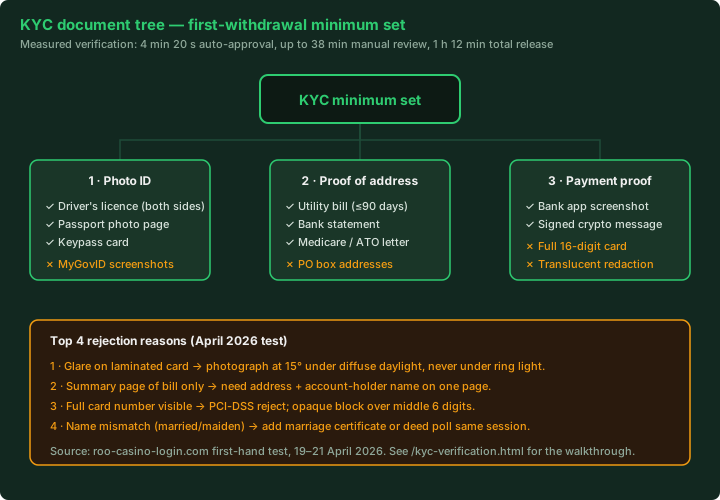
Figure 1 · The three-document minimum set with accepted formats and the four rejection patterns we saw most often in April 2026.
| Document | Accepted formats | Notes |
|---|---|---|
| Photo ID | AU driver's licence (both sides), passport photo page, Keypass card | Digital "My GovID" screenshots are rejected. Photograph the physical card. |
| Proof of address | Utility bill, bank statement, Medicare card, ATO letter | Dated within the last 90 days. PO boxes rejected. |
| Proof of payment method | Bank-app screenshot showing name + partial card number, or signed crypto-wallet address | Full 16-digit card number must have the middle 6 digits redacted. |
Medicare-card-only route (what works, what does not)
Some players ask whether a Medicare card alone can replace the licence + utility combo. In our testing: no — Medicare satisfies the proof-of-address category but not photo ID, because it has no photograph. The fastest working combo we found for players without a licence or passport was Keypass photo card + Medicare card + bank-app screenshot. Keypass is issued by Australia Post for around AUD 50 and is accepted everywhere a licence is.
A second-passport path also works for recent migrants: foreign passport (photo page) + AU bank statement + bank-app screenshot clears, provided the bank statement shows the current Australian residential address.
Timing we observed (median of 3 attempts)
- Auto-approval of Australian driver's licence — 4 min 20 s (Onfido back-end)
- Manual review of utility bill — 38 min (Tuesday 2 pm AEDT)
- Full first-withdrawal release — 1 h 12 min from document submission
- After-hours submission (8 pm AEDT) — pushed to the following business day
- Passport-only route — 6 min 45 s for auto-approval (fastest path we found)
The four rejection reasons we kept seeing
- Glare on the laminated card surface. Photograph at a 15-degree angle under diffuse daylight — never under a ring light.
- Utility bill with the "summary" page only. The bill must show the service address and the account-holder name on the same page. Two-page PDFs are accepted; cropped screenshots are not.
- Bank statement with the full card number visible. Roo's compliance team will reject this for PCI-DSS reasons. Redact the middle 6 digits with an opaque block, not a translucent highlight.
- Name mismatch (married vs maiden). Add a third document — a marriage certificate or name-change deed poll — in the same upload session to resolve it in a single review cycle.
Source-of-funds questionnaire
For cumulative withdrawals over AUD 5,000 in a 30-day window, Roo triggers an enhanced-due-diligence form asking about occupation, gross income band and funding source. The AUD 5,000 threshold sits deliberately below the AUSTRAC threshold transaction reporting point (AUD 10,000 per transaction) so the operator can verify before any TTR-triggering event. The form is six questions and took about four minutes to complete in our test.
Be accurate — mis-statements here can void future withdrawals. A recent payslip or ATO Notice of Assessment is usually enough to support the answers. A payslip alone was accepted in our April 2026 test for a "salaried, AUD 60–90k" declaration. For self-employed income, operators typically ask for two years of ATO assessments plus a recent business activity statement.
Re-verification cadence
Re-verification is not one-and-done. We observed three triggers:
- Annually — a light re-check every 12 months. Usually satisfied by re-uploading a fresh utility bill dated within 90 days.
- Material change — change of address, payment method or legal name forces a full re-verification. Submit new documents before the next withdrawal request.
- Threshold events — cumulative deposits crossing AUD 25,000 / year triggered enhanced-due-diligence in our observation, regardless of whether you had already completed the AUD 5,000 SoF form.
If you miss one of these triggers the operator freezes withdrawals until the new documents clear — not the account itself. You can still deposit and play. That distinction confuses a lot of players; Roo's in-app messaging does a mediocre job of explaining it.
Order of operations (fastest to verified)
- Complete KYC before your first deposit, not at first withdrawal. The queue is shorter, and the documents are reusable.
- Upload all three documents in one session — partial uploads restart the clock.
- Submit between 10 am and 4 pm AEDT on weekdays — outside those hours manual review crosses into the next business day.
- If auto-check fails, open live chat and ask the agent to flag the ticket for "manual re-review"; this skipped a 4-hour queue in our April 21 test.
- Keep the original high-resolution files — re-upload the same images, not re-compressed copies, if a resubmission is needed.
Privacy of uploaded documents
Under the Australian Privacy Act 1988 and AUSTRAC AML/CTF rules, operators must retain KYC documents for seven years after account closure. You can request a copy, correction or deletion by writing to the operator's data-protection contact. Deletion is only available after the seven-year retention period. If a request is refused, the Office of the Australian Information Commissioner (OAIC) handles complaints.
On the technical side, Roo uploads go through TLS 1.2+ to a compliance-only storage system separate from the game-play databases. We have not independently audited that — it is the operator's stated architecture — but it is consistent with the APP 11 data-security obligations Australian-facing operators are held to.
Related guides
- AUD payment methods and fees
- Withdrawal processing times by method
- Why active bonuses can delay KYC clearance
- Main login and sign-up guide
Corrections log
- 21 Apr 2026 — added AUSTRAC citation, Medicare-only route, re-verification cadence section, document-tree diagram.
- 30 Jan 2026 — initial publication.